Why Is Xi’an Famous for the Terracotta Army?
Why Is Xi’an Famous for the Terracotta Army?
Let me tell you about the greatest archaeological discovery of the 20th century.
In 1974, a group of farmers in northern China were digging a well. They were looking for water. What they found instead changed history.
A few meters underground, they hit something hard. Not rock. Not water. Clay. Thousands of pieces of clay. Human-shaped clay. With faces. With weapons. With history.
They had stumbled upon the Terracotta Army of Emperor Qin Shi Huang.
The discovery took the world by storm. And it made one ancient city famous beyond anyone’s imagination.
That city is Xi’an. And this is why the Terracotta Army matters.
## Who Was Emperor Qin?
Here is the man behind the army: Qin Shi Huang.
He was the first emperor of a unified China. Before him, China was divided into seven warring states. After him, China was one nation.
He was born in 259 BCE. He became king at age 13. By age 38, he had conquered all seven states and declared himself Emperor of China.
He was ambitious. He was ruthless. He was brilliant.
He standardized weights and measures across China. He built roads and canals. He connected existing walls into the Great Wall. He created a bureaucracy that would last for 2,000 years.
And he wanted to live forever.
This desire drove much of what he did. He sought immortality potions. He obsessed over death. He believed his empire would last forever.
And he wanted an army to protect him in the afterlife.
## Why Build an Army of Clay?
Here is the thinking behind the Terracotta Army: ancient Chinese believed in the afterlife.
Qin Shi Huang was not content to rule just the living. He wanted to rule the dead as well. He wanted an army to protect him when he passed to the next world.
But there was a problem: real soldiers were needed to defend the living empire. You could not bury thousands of soldiers with an emperor. The empire would collapse.
So Qin did what Qin did best. He found a solution that combined ingenuity, scale, and his legendary obsession with permanence.
He would make an army from clay. Clay soldiers that would never die. Clay soldiers that would stand guard for eternity.
This was not new. Other emperors had buried servant figures with themselves. But nobody had ever done anything on this scale.
Qin’s army would be an army of the dead, guarding an emperor of the dead, in an empire of the afterlife.
## The Discovery That Shocked the World
Here is the story of how we found them: 1974.
For over 2,000 years, the Terracotta Army lay hidden beneath the earth. The pit where they rested was covered by a mound. Over centuries, the mound became farmland. Farmers plowed their fields above the greatest archaeological treasure in Chinese history, never knowing what lay below.
Then in March 1974, a group of farmers from Xianyang county decided to dig a well. They needed water for their crops. They chose a spot near the Qin mausoleum.
What they found instead of water was the greatest army ever discovered.
The farmers reported their find to local authorities. Archaeologists arrived. And what they uncovered exceeded anything they had imagined.
Pieces of clay. Fragments of pottery. Gradually, they pieced together not just an army, but an entire underground complex.
The excavation took decades. It continues to this day. New warriors are still being discovered and restored.
## The Scale That Defies Belief
Here is what makes the Terracotta Army impossible to ignore: the numbers.
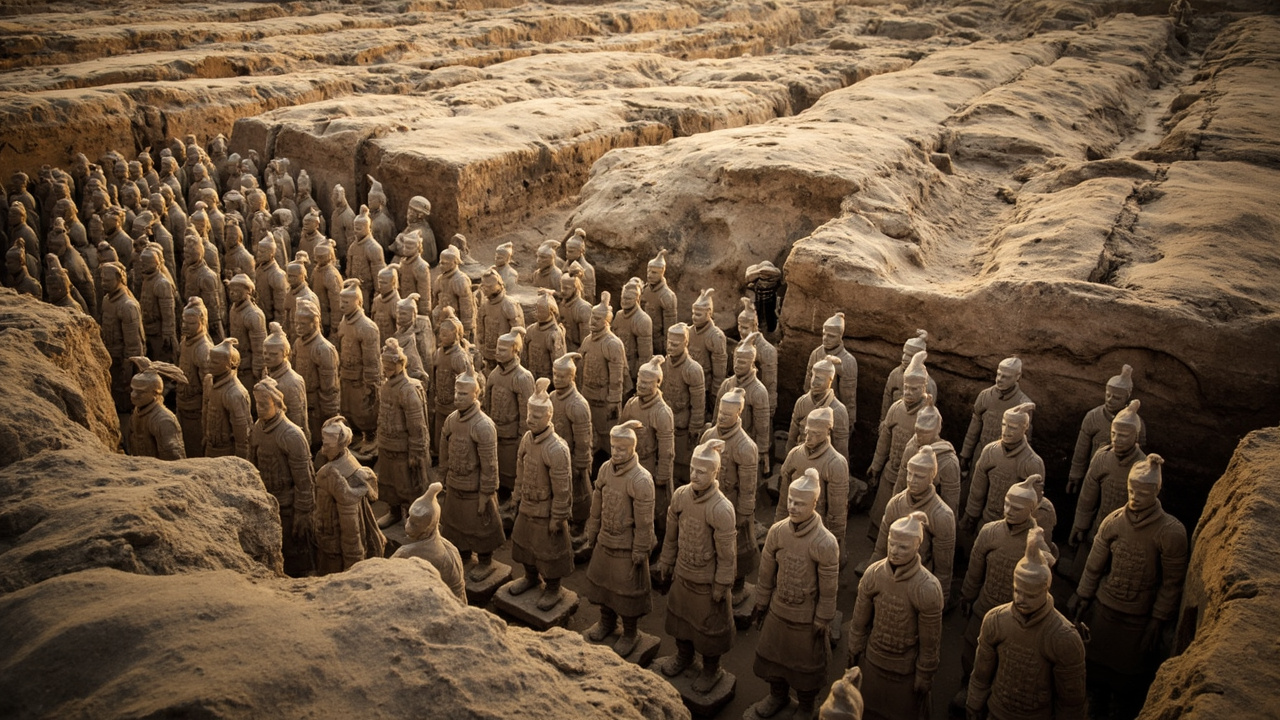
Over 8,000 clay warriors have been unearthed. Each one stands approximately 1.8 meters tall. Each one has unique facial features. No two faces are exactly alike.
Alongside the warriors, archaeologists have found 130 chariots. They have found over 670 horses. They have found tens of thousands of weapons.
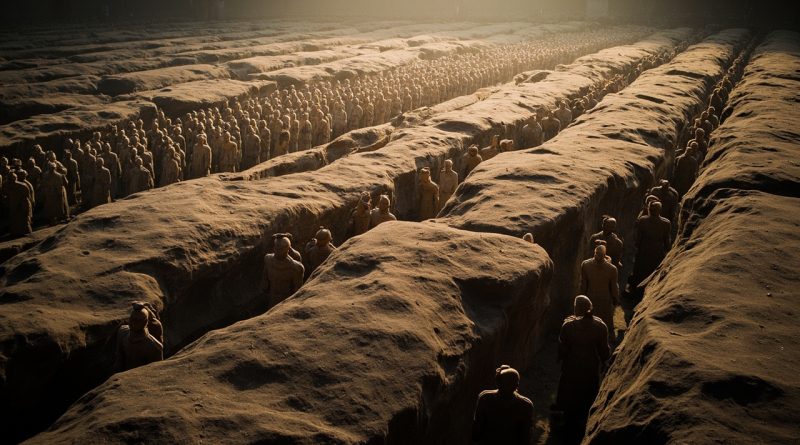
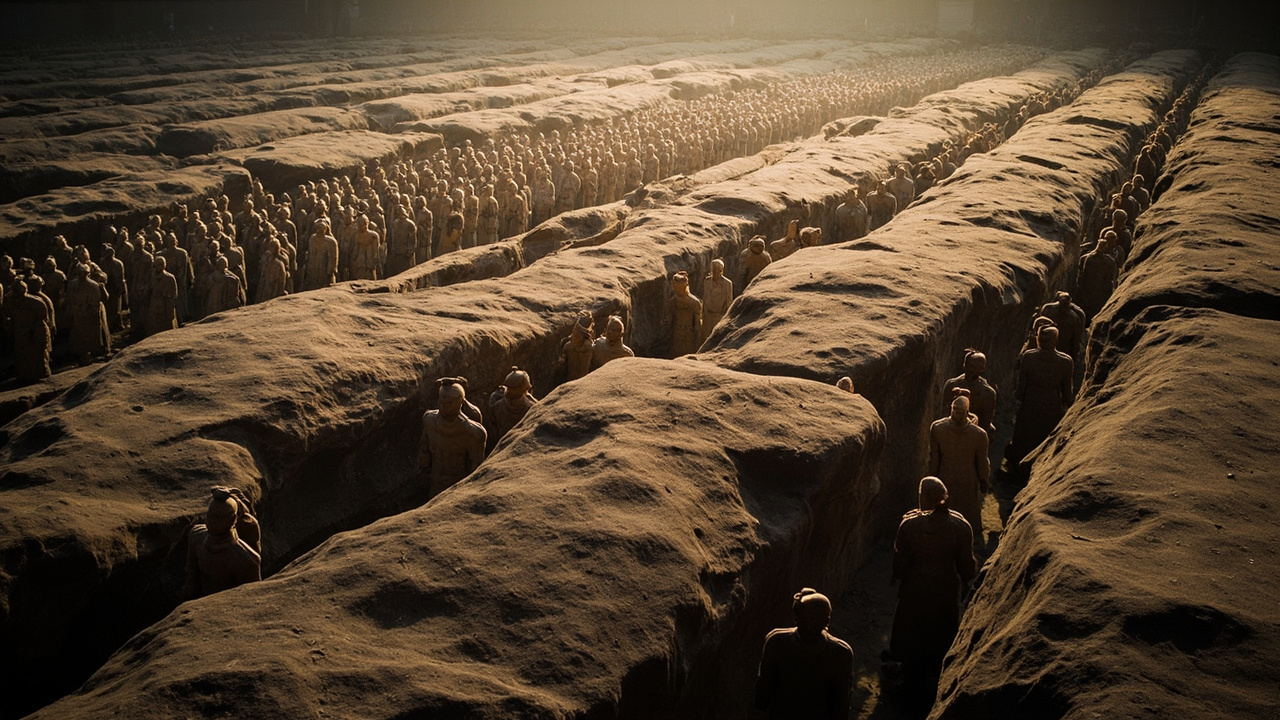
The army was arranged in battle formation. Infantry. Cavalry. Archers. Commanders. All in their proper positions.
The army was once equipped with real bronze weapons. When archaeologists tested them, they found the blades still sharp after 2,000 years. The metalwork was so advanced that modern metallurgists were stunned.
Each warrior was originally painted in vivid colors. Red. Green. Pink. Black. Over time, the colors faded. But for 2,000 years, this army stood in full color, ready for battle.
## The Emperor’s Tomb Still Unexcavated
Here is what we have not found: the tomb itself.
The Terracotta Army is just the garrison. The tip of the archaeological iceberg. According to historical records, the actual tomb of Emperor Qin contains an entire underground palace.
The tomb is said to have mercury rivers flowing through it. Models of palaces and scenic areas. Treasures beyond counting.
For over 2,000 years, no emperor has disturbed it. Not because they did not try. But because the engineering required to reach it safely surpasses current technology.
Han dynasty records describe the tomb in detail. They describe mechanical devices and booby traps. They describe crossbows positioned to fire at anyone who enters without authorization.
Modern archaeologists are in no rush. They want to preserve what is there. They have already spent decades just on the outer areas.
The Terracotta Army guards the path to the emperor’s final resting place. And that resting place remains one of the greatest mysteries of ancient China.
## Why Every Face Is Different
Here is the detail that makes the army deeply human: the faces.
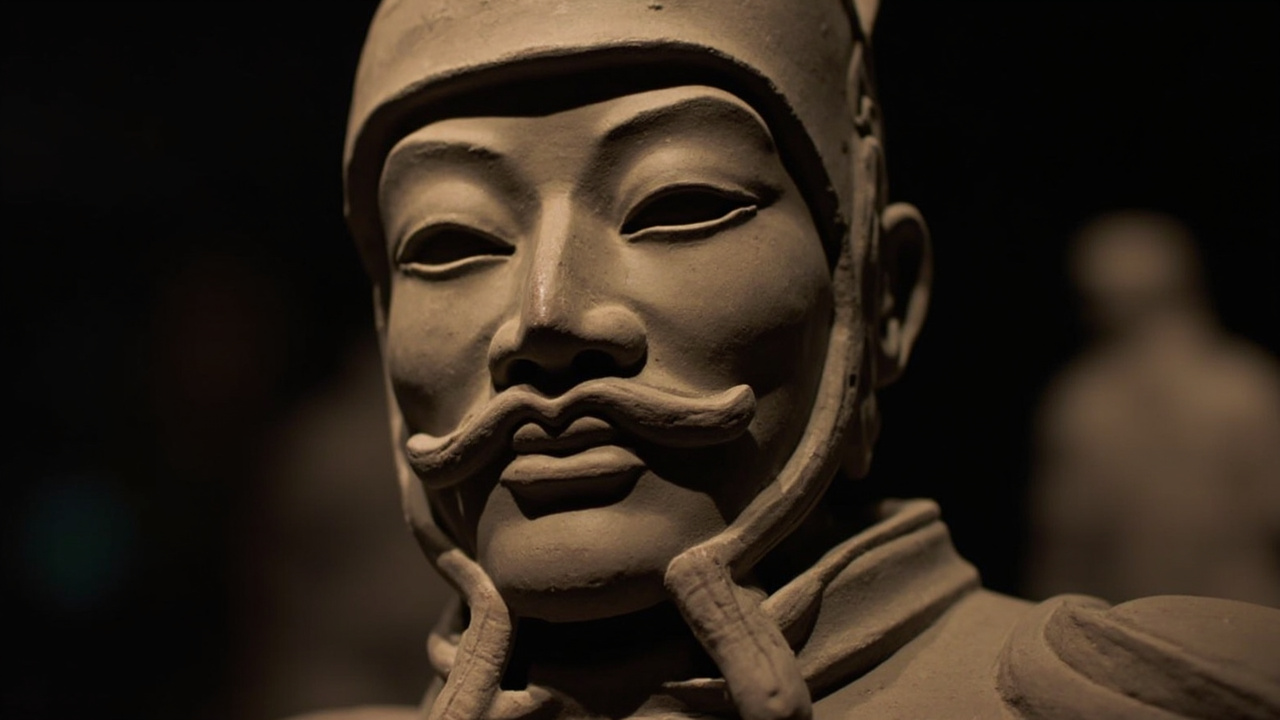
When you stand at the Terracotta Army, you see thousands of identical clay figures. From a distance, they look the same. But step closer, and you see the truth.
Every face is different.
Archaeologists have identified several distinct types. Some have mustaches. Some do not. Some have goatees. Some have top knots. Some have wide foreheads. Some have narrow jaws.
The theory is that each warrior was modeled after a real soldier in the Qin army. The emperor wanted his clay army to be a true reflection of his real army. Every unit. Every face. Every detail.
This means when you look at these warriors, you are looking at the faces of real men who lived over 2,000 years ago. Farmers who became soldiers. Soldiers who became immortal.
One archaeologist said the faces show individual character. Some look serious. Some look confident. Some look young. Some look old. These are not anonymous clay figures. They are individual human beings, preserved forever in fired earth.
## The Numbers That Stagger the Mind
Here is what draws millions of people to Xi’an every year: the statistics.
Since the museum opened to the public, over 160 million people have visited the Terracotta Army. That is more than the population of most countries.
In 2024 alone, 11.61 million people visited. During the three-day Qingming holiday that year, 158,551 visitors came. The day before Qingming saw over 55,000 visitors in a single day.
The Terracotta Army has become one of the most visited archaeological sites in the world. It draws more visitors than Pompeii. More than the Egyptian pyramids. More than almost any other ancient site on Earth.
And each visitor leaves with the same question: how did humans build this over 2,000 years ago?
## Xi’an Before and After
Here is the transformation the Terracotta Army created: Xi’an was already ancient.
Before the discovery, Xi’an was known as Chang’an. It had been capital of Chinese dynasties for centuries. It had the ancient city walls. It had the Giant Wild Goose Pagoda. It had history everywhere.
But it was considered a backwater compared to Beijing or Shanghai. A city of the past, not the future.
Then the farmers dug their well. Then the world discovered the army.
Now Xi’an is one of China’s most famous tourist cities. New museums were built. New infrastructure appeared. International flights arrived. Hotels and restaurants followed.
The Terracotta Army transformed Xi’an from a historical footnote into a global destination. And it transformed Chinese archaeology from a regional pursuit into a world-renowned field.
Today, Xi’an stands as living proof that China has been making history for over 2,000 years. And some of that history is buried just meters underground, waiting to be found.
## Why It Still Matters
Here is what the Terracotta Army teaches us: scale matters.
In a world where most ancient monuments were built for religious purposes, the Terracotta Army stands alone. It was built purely for one man’s belief in his own immortality.
Qin Shi Huang wanted to rule the afterlife as he ruled the living. He wanted an empire that would never end. He wanted to be remembered forever.
He succeeded.
Over 2,000 years later, his name is still known. His army still stands. His tomb remains unopened. His ambition still shapes the landscape.
And millions of people every year make pilgrimages to see the army he created. They stand before thousands of clay warriors and feel the weight of history.
This is what makes the Terracotta Army important. It is not just ancient art. It is ancient ambition. It is the largest memorial to one man’s ego in human history.
And somehow, through all the dynasties and wars and revolutions that followed, it survived.
## The Truth
So why is Xi’an famous for the Terracotta Army?
Because in 1974, farmers digging a well found clay soldiers buried for 2,000 years. Because those soldiers belonged to the first emperor who unified China. Because that emperor wanted to conquer death itself, and built an army to protect him in the afterlife.
Because no one had ever seen anything like this before. Over 8,000 warriors. Each unique. Each standing in formation. Each representing real men who lived over two millennia ago.
Because the Terracotta Army is not just a tourist attraction. It is a window into the mind of the man who built modern China. Ambitious. Ruthless. Forward-thinking. Obsessed with permanence.
The next time you see photographs of the Terracotta Army, remember: these are not just statues. These are the ghosts of Emperor Qin’s soldiers, standing eternal guard over an emperor who refused to accept that anything, even death, could defeat him.
Xi’an is famous because it holds the army. But the army is famous because it holds history itself.